Building Tips
The Steel You Never See: Anchoring a House
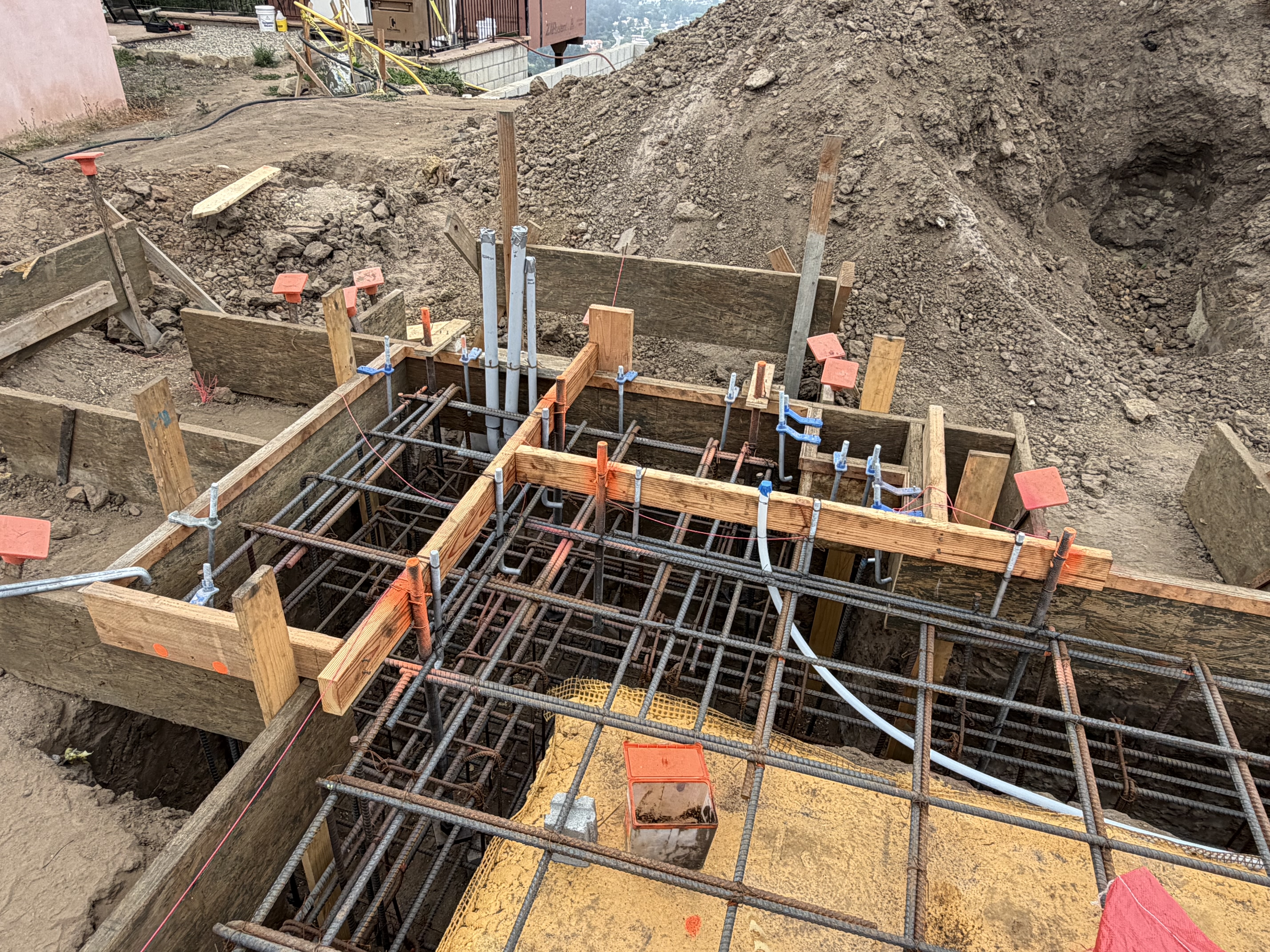
Walk through a finished custom home and you see wood, drywall, paint, and stone. None of it is what keeps the house on the ground. That job belongs to steel - anchor bolts, hold-downs, and base plates set into the foundation before a single wall goes up. Once the concrete cures, that hardware is buried for the life of the building, so it all has to be right before the pour. Here is the family of embedments and the job each one does.
1. One Idea: A Continuous Load Path
Every piece of steel in a foundation exists to keep one thing unbroken - the load path. When wind hits a wall or an earthquake shakes the framing, that force has to travel somewhere: from the wood frame, into a metal connection, through the concrete, down into the footing, and out into the soil. Break any link in that chain and the house fails at the break.
The embedments are those links. Each one is engineered to carry a specific force - sliding, tipping, shear in a tight space, or the point load of a steel column - from the wood into the concrete.
They go in before the pour because there is no second chance. Cast-in hardware is locked in the concrete exactly where the framing will land. Bolt it on afterward and you are trusting a few fasteners drilled into cured concrete instead of steel anchored deep in the footing. We set it now, while the rebar cage is open and every bolt can be tied into the structure around it.
2. Anchor Bolts: Stopping the Slide
The most common embedment is the anchor bolt - the bolt standing up out of the concrete every few feet along the base of every wall. Its job is to fight shear: the sideways force that wants to slide the whole wood structure off the smooth top of the foundation.
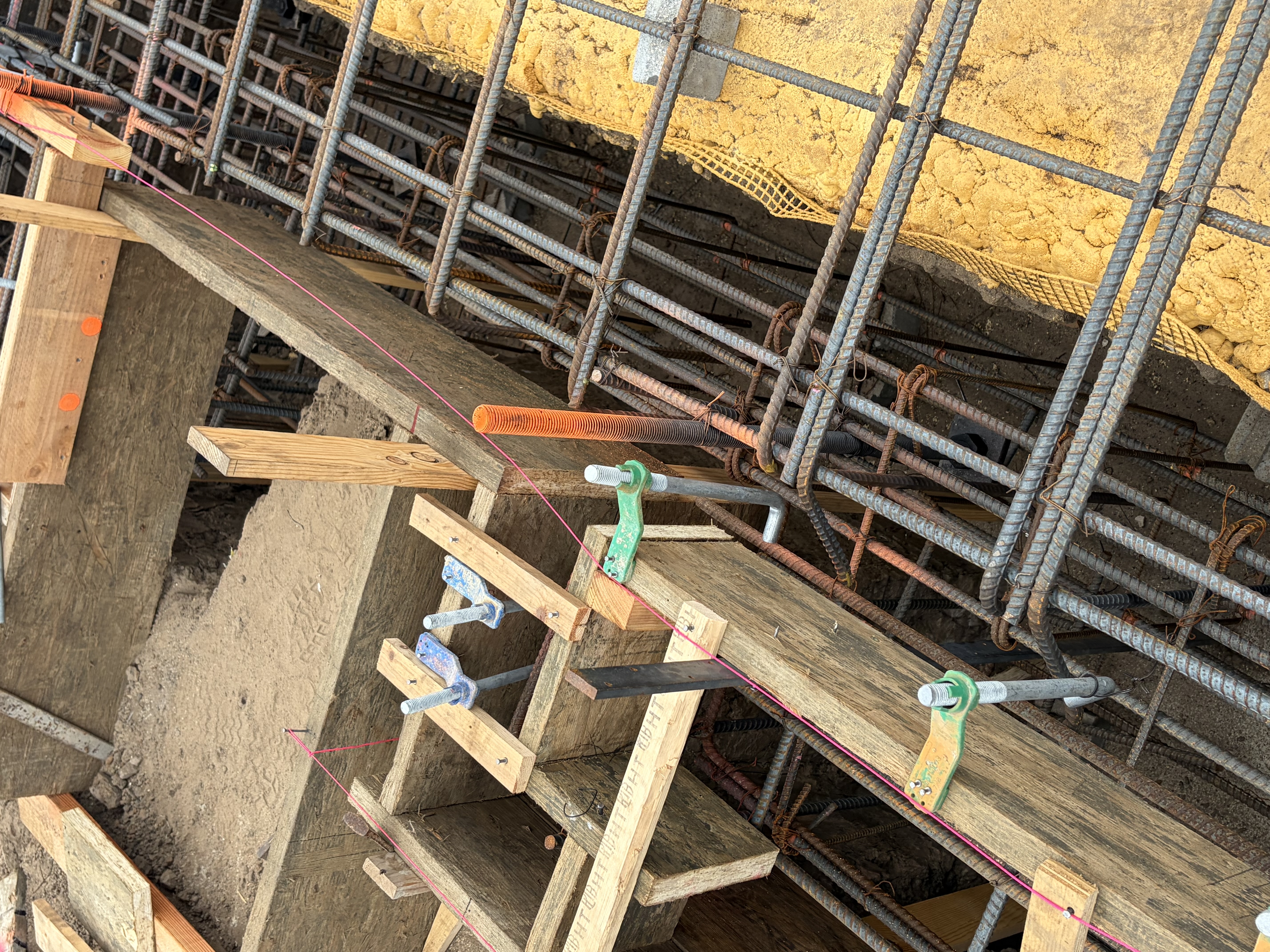
Anchor bolts connect the sill plate - the pressure-treated 2x that sits flat on the concrete - to the footing. On this job they are 5/8-inch bolts, and the layout is not casual:
- Centered on the plate. The bolt sits in the middle of the sill so there is full wood on both sides. Too close to an edge and the plate can split out under load.
- Evenly spaced along the run. Code caps the spacing, and in our seismic zone it tightens. Even spacing spreads the holding power down the entire wall instead of leaving weak gaps.
- Two per piece, one near each end. Every cut length of sill gets at least two bolts, one within a foot of each end, so no piece of wood is left unanchored.
- Plate washers. In a seismic zone each bolt gets a 3-inch square steel plate washer, so the bolt pulls against a wide bearing surface and the nut cannot tear through the wood.
3. Hold-Downs: Stopping the Tip-Over
Anchor bolts stop sliding, but they do not stop a wall from tipping. Push hard enough on the top of a wall and it acts like a sail - one end drives down while the other levers up and tries to peel away from the foundation. Engineers call that the overturning force, and it is strongest at the ends of shear walls, the rigid plywood-sheathed walls that brace the house.
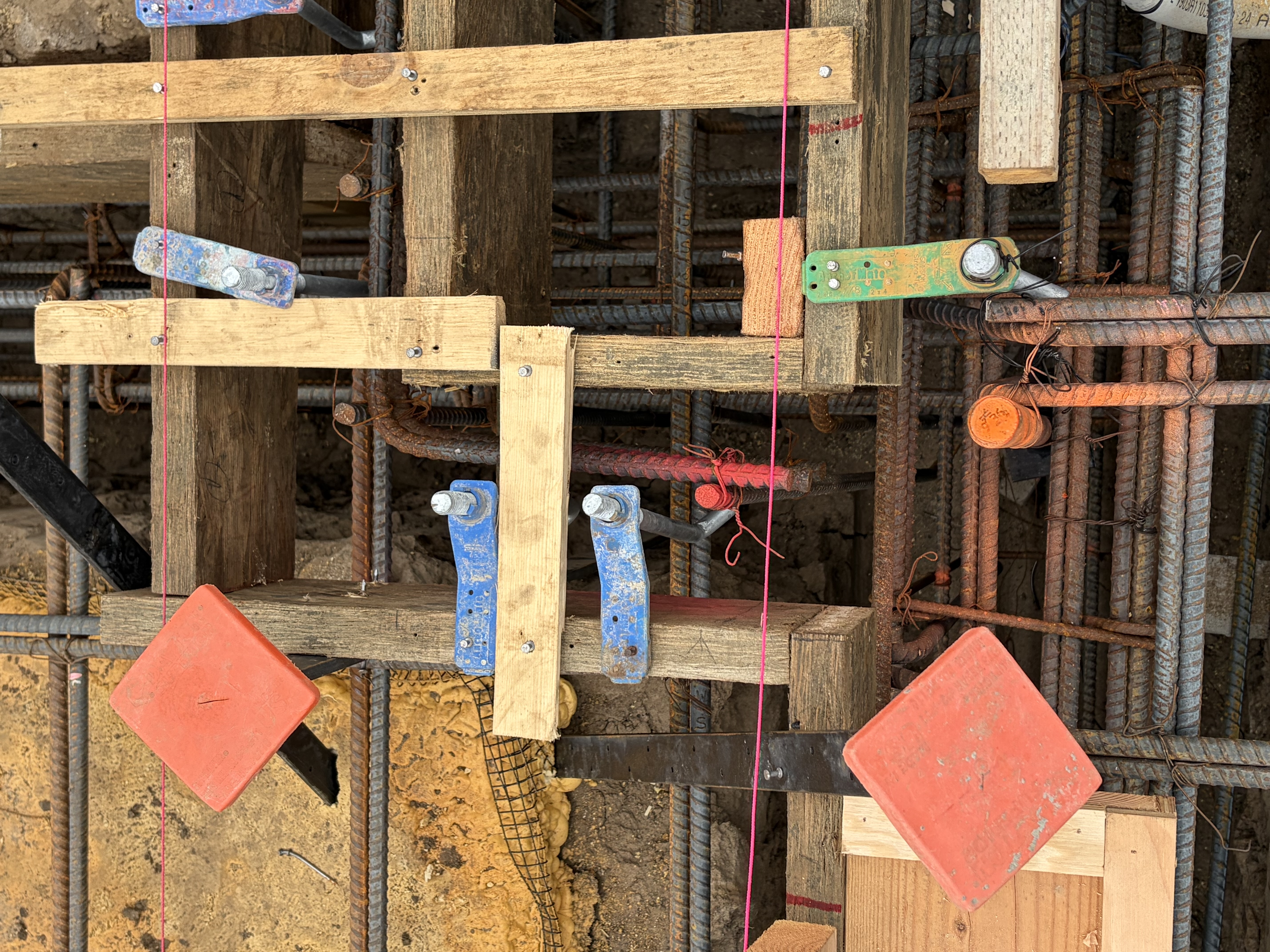
A hold-down handles it. Instead of relying on the sill plate, the hold-down bypasses it entirely and ties a vertical framing post straight down to the footing. The bracket bolts to the post up top with heavy screws, and a length of all-thread runs down into a Simpson SSTB anchor cast deep in the concrete.
This is where the varying sizes come in. The engineer matches the hardware to the calculated uplift, and it scales hard:
- HDU2 pairs with an SSTB20 anchor for lighter loads.
- HDU8 and HDQ11 step up to SSTB28 and SSTB36 anchors for walls fighting thousands of pounds of uplift.
The bigger anchors need room, so the footing gets deepened where they land to give the steel enough concrete around it.
The hold-down only works if the whole chain is made - post to bracket to anchor to footing. Skip one bracket and you have a wall that looks braced and is not.
4. Strong-Walls: Shear Where There Is No Room
Sometimes the wall that needs to brace the house is mostly opening - a garage door or floor-to-ceiling glass leaves a solid strip too narrow for a conventional shear wall. There we set a prefabricated WSWH24 Strong-Wall, which packs the bracing of a much wider wall into a 24-inch footprint, anchored by the same cast-in family of hardware. We covered that one in depth already - see our breakdown of Strong-Walls.
5. Column Base Plates: Spreading a Steel Load
The last embedment carries the heaviest, most concentrated load. Where a steel column lands - an HSS 4x4 or 6x6 tube carrying a floor or roof above - all of that weight comes down on one small point. Set that column straight on concrete and it would punch through.
The fix is a base plate: a thick steel plate, 14 inches square and 7/8-inch thick, welded to the bottom of the column. It spreads the column’s point load across a wide patch of footing so the concrete is not crushed. Holding it down are four cast-in anchor bolts in a square pattern - the templated bolt groups standing in the rebar before the pour.
Two details make it work:
- Double nuts level it. A nut below the plate and a nut above let the crew set the column dead-level and plumb before anything is locked in.
- Dry pack transfers the load. Once set, the gap under the plate is packed solid with non-shrink grout so the compression load bears evenly into the footing instead of on the bolts.
And the part that fits the title: on this job those steel columns get clad in stone. The structural steel doing the heavy lifting disappears inside a finished stone column - the strength is there, you just never see it.
Key Takeaways
- Every embedment exists to keep one continuous load path - frame to connection to concrete to footing to soil.
- Anchor bolts fight sliding; they are centered on the sill, evenly spaced, and double-bolted on every piece of plate.
- Hold-downs fight overturning at shear-wall ends, tying the post straight to the footing, and they scale with the calculated uplift.
- Strong-Walls brace narrow openings the same way, in a 24-inch footprint.
- Base plates spread a steel column’s point load, leveled on double nuts and bedded in non-shrink grout.
- All of it goes in before the pour, because cured concrete gives no second chance.